
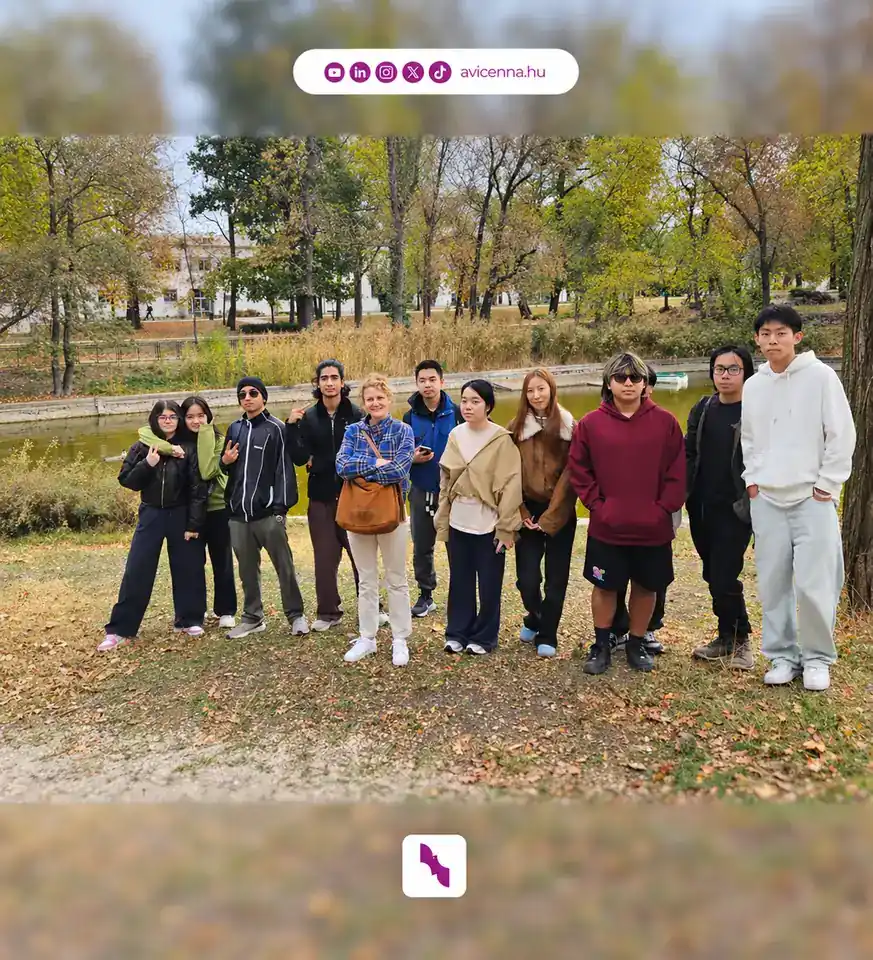

On 20 October 2026, a group of Grade 10 and Grade 11 students from Avicenna International College took part in an Orczy Park treasure hunt and historical quiz competition. Their destination was a place with layers of history: a former family garden, the grounds of a military academy and a public park used by people living in Budapest today.
Known locally as Orczy-kert, the park is in Józsefváros, Budapest’s eighth district, or Budapest VIII. kerület. For AIC, based at Orczy út 3-5, 1089 Budapest, this was an opportunity to explore the history of the neighbourhood around the college.
The Orczy Park Treasure Hunt in Photographs
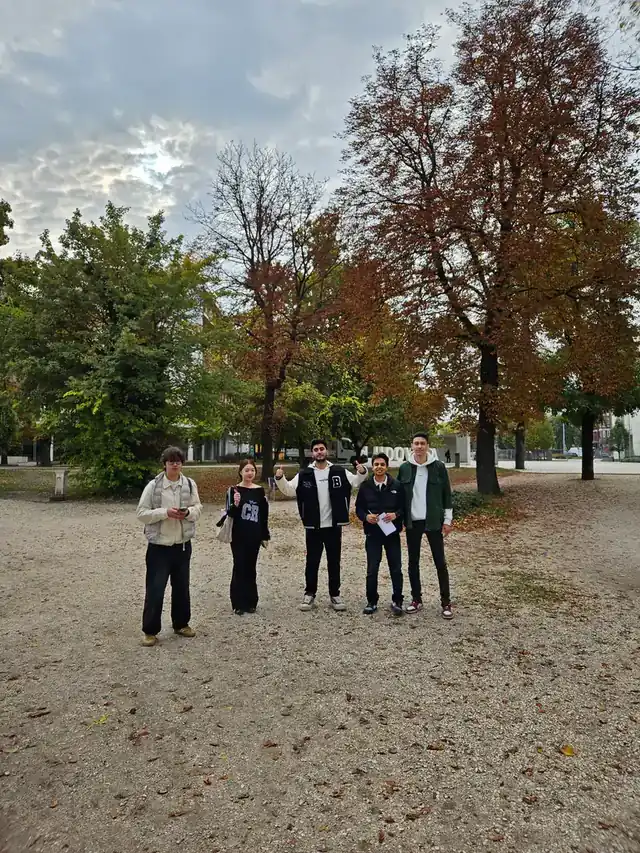
The activity combined a statue photo treasure hunt with a historical quiz competition. Students took photographs during the visit and learnt about both the park and the Ludovika Academy. Borbála Dinnyés, AIC’s teacher of Hungarian and English and Grade 10 homeroom teacher, reported that they enjoyed the activity.
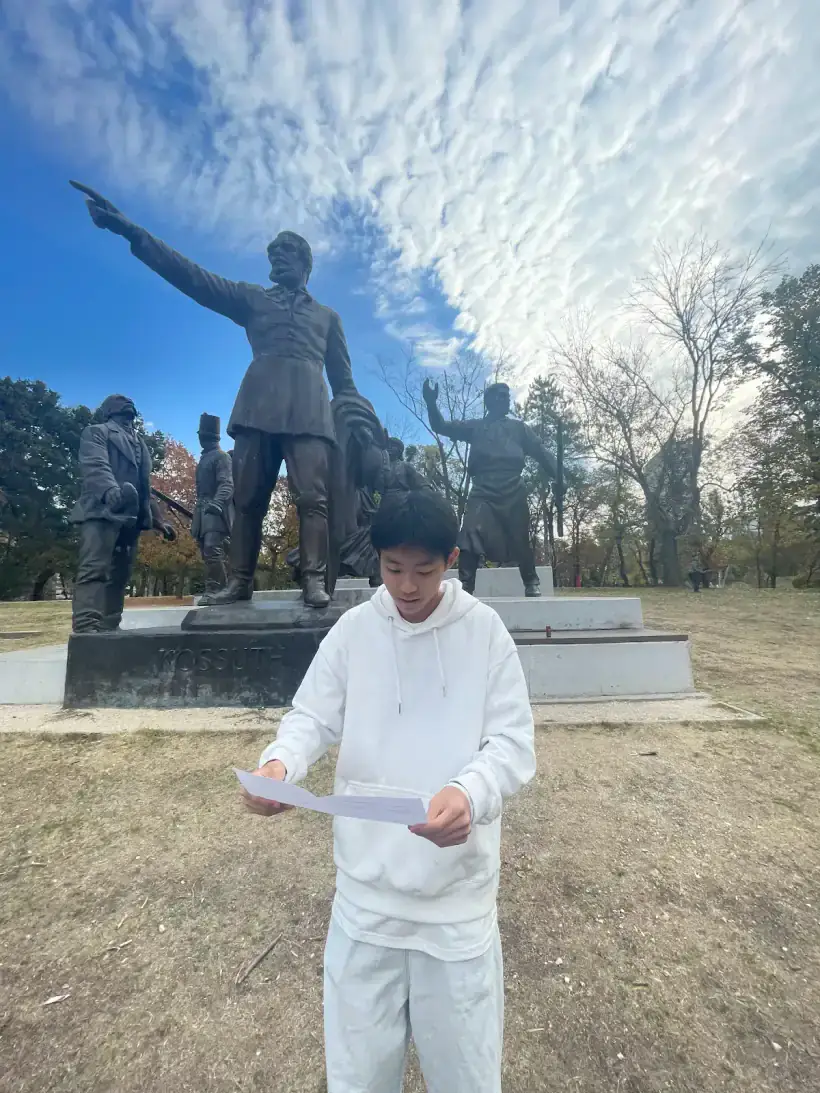
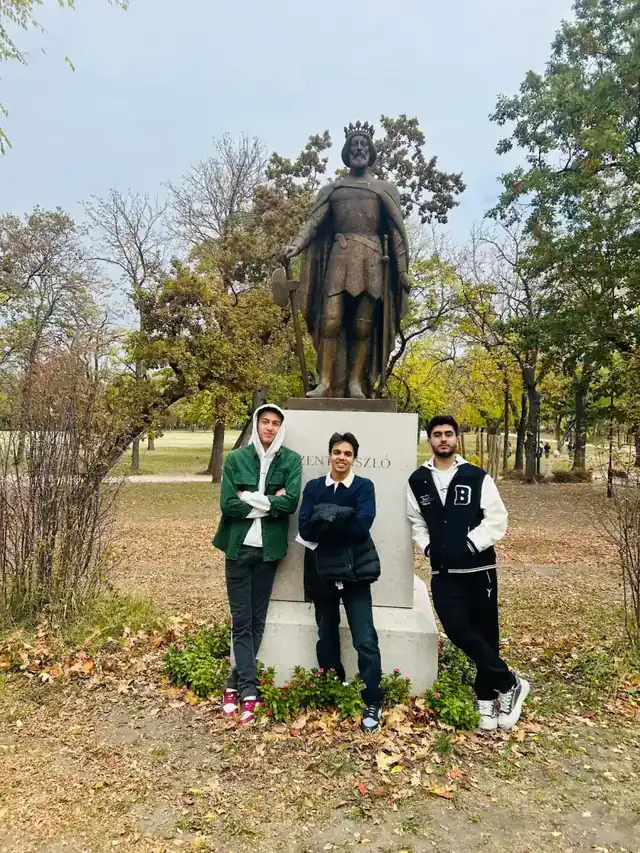
The photographs give the outing a more personal perspective. In one, a student looks down at a printed sheet with the Kossuth monument behind him. In another, three classmates stand at the base of the Szent László statue. A wider group photograph beside the water places the visit within the park’s open landscape.
Kossuth and Szent László: The Statues in the Students’ Photos
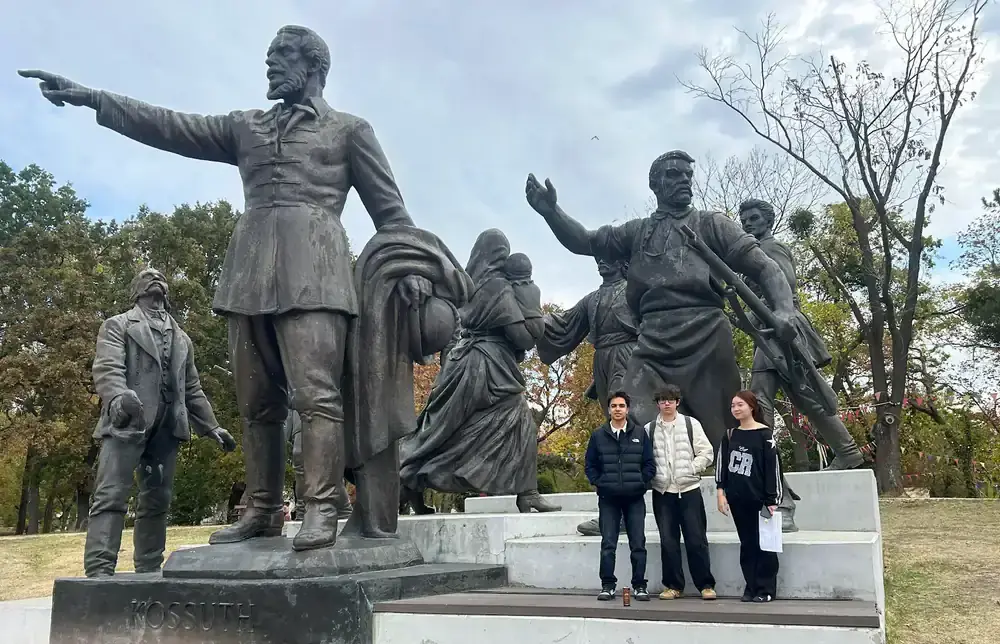
The Kossuth monument is recognisable by its central figure with an outstretched arm and the surrounding group of figures. Its own journey is part of the story of Budapest’s public spaces. Originally erected on Kossuth Square in 1952, the sculpture group was installed in Orczy Park in 2018.
The university’s account of the relocation explains that the arrangement changed for the park setting. The figures were positioned so visitors could walk around the composition rather than see it mainly from one direction. Looking at the students’ photographs, the scale of the figures and their relationship to the people standing beside them become especially clear.
Another photograph shows the statue of Szent László, known in English as Saint Ladislaus. The crowned figure holds an axe, and his name appears on the pedestal. The statue placed on the Ludovika Campus in 2021 is a copy of an earlier work by Sándor Oláh. The original was moved to Sümeg after the Second World War; the copy was made by sculptor János Lestyán Goda.
Together, the two monuments offer different ways to think about historical memory. One was relocated and rearranged, while the other returned to the park as a copy. A photograph can capture their appearance, but learning their stories changes how we see them.
Orczy Park History: From Family Garden to Public Space
The history of Orczy-kert reaches back to 1783, when Baron Lőrinc Orczy purchased the land. His son László developed the garden, appointing landscape designer Bernhard Petri in 1794 to plan an English landscape garden. By the end of the eighteenth century, it had opened to the public.
Its connection with the academy began in 1829, when the property was acquired for the planned military institution. The park’s lake also belongs to this period: the basin was excavated in 1832, with its sluices completed the following year.
That detail gives the group photograph beside the water another layer of meaning. The lake is not simply a pleasant background for a school outing. It is part of a landscape shaped as the academy took form nearly two centuries ago.
The Ludovika Academy and Budapest’s Educational History
The Ludovika Akadémia was established in law in 1808 to train Hungarian military officers. It was named in honour of Queen Maria Ludovika, who contributed funds from her coronation gift towards its creation.
Architect Mihály Pollack designed the academy building, which was constructed between 1830 and 1836. Completion did not mean that the institution immediately began its intended work. In 1838, during the great flood of Pest, the building sheltered people displaced by the flooding and housed collections rescued from the National Museum. Regular Hungarian officer training began there in 1872.
The distinction matters: the academy’s founding, the construction of its building and the start of regular teaching were separate events. Today, the former academy building and Orczy Park form part of the Ludovika Campus of the University of Public Service. The university’s campus renewal programme included the restoration of both the historic setting and the public park.
Learning Beyond the Classroom in Budapest
AIC’s article on experiential learning in science explores a related idea: observation and experience can give students a starting point for deeper inquiry. The subject here was local history rather than science, but the connection between noticing something and wanting to understand it remains relevant.
The visit also sits alongside other opportunities to explore the city, including AIC students’ experiences at Researchers’ Night in Budapest. These are different activities, but both bring students into contact with places and knowledge beyond their usual classrooms.
The outing began with a photo treasure hunt and a quiz. Its wider interest lies in the details the setting reveals: a monument that moved across Budapest, a statue recreated for the park, and a lake with roots in the academy’s earliest years. There is a great deal of history close to AIC’s own address.
For families considering AIC’s high school programme, the Orczy Park photographs offer a specific glimpse of student life: classmates exploring a shared neighbourhood and recording it from their own perspective. Readers who would like to learn more about studying at the college can contact the AIC admissions team.